

 Español
 عربي
عربي Русский
 한국인
한국인 Português
 Türkçe
 Italiano
 Français
 German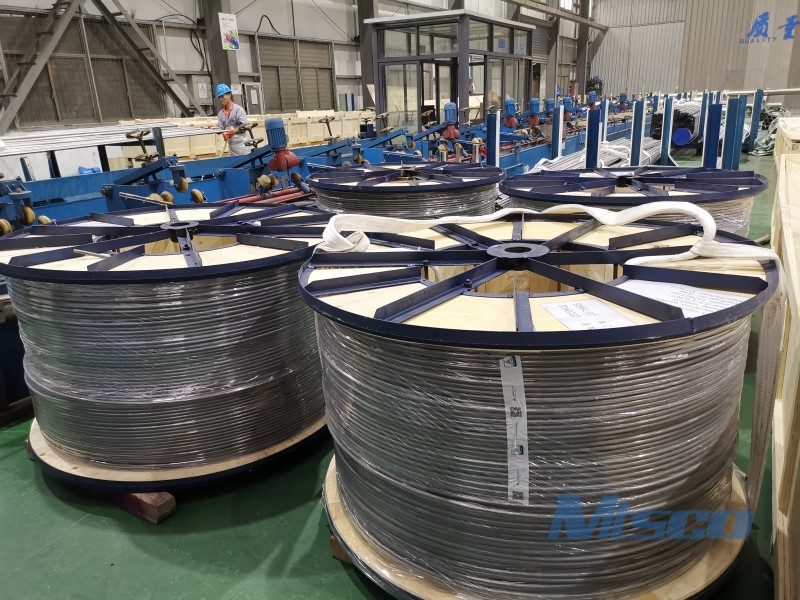
--High-Performance Continuous Tube Solutions for Extreme Industrial Environments
Explore how welded coiled tubing maximizes SWHE efficiency. Learn material selection and laser welding strategies for leak-free high-pressure performance.
The core value of the welded coiled tubing in the Spiral Wound Heat Exchanger (SWHE) lies in its ultra-long continuous tubes and stable weld quality, achieving higher heat exchange efficiency and lower leakage risk under high pressure differentials, thermal cycling, and corrosive media.
Why does SWHE prefer welded coiled tubing?
SWHE forms a large heat transfer surface area through multi-layer spiral coils. The tubing requirements differ from conventional straight tubes:
•Continuous length: Reduces the number of butt welds, lowering potential leak points and the probability of downtime for maintenance.
•Forming-friendly: The coil requires controllable yielding/elongation and springback to ensure the accuracy of the winding geometry.
•Stable heat transfer: Consistency between wall thickness and outer diameter directly affects flow resistance, heat transfer coefficient, and tendency to frost/fouling.
Manufacturing processes and material selection standards under harsh operating conditions: As a pressure-bearing heat transfer component, the coil must withstand drastic temperature fluctuations and extremely high internal fluid pressure.
High-frequency laser welding process: Top-tier heat exchange coils require 100% laser welding combined with continuous bright annealing. This eliminates internal processing stress in the tubes, ensuring the mechanical properties and corrosion resistance of the weld zone are highly consistent with the base material.
Precise material matching: 304/316L austenitic stainless steel is typically used in conventional cryogenic environments; however, for highly corrosive media or extreme operating pressures, upgrade to Duplex 2205 duplex steel, or even nickel alloys such as Alloy 625, is necessary to meet stringent physical and chemical requirements.
Selection and Acceptance: Material matching media: 304/316L is suitable for various operating conditions; for chloride-containing, sulfur-containing, or more severe corrosion, duplex steel/nickel alloy routes can be considered.
Complete process flow: Continuous welding → Cold working (e.g., cold drawing) → Bright annealing/solution treatment → Dimensional and surface control. Inspection should focus on weld seams: It is recommended to clearly define UT/ET, airtightness/hydraulic pressure testing, and a 100% weld seam inspection strategy.
MTSCO employs a closed-loop process in the field of welded coiled tubing/control line: laser welding + cold drawing + bright annealing, and manages quality using the ISO/PED system; 100% high-pressure testing (up to 100MPa) and full-process traceability quality control. For equipment configurations like SWHE with long pipes and few interfaces, we excel at using stable supply and testing capabilities to help customers eliminate downtime and leakage costs upfront.