

 Español
 عربي
عربي Русский
 한국인
한국인 Português
 Türkçe
 Italiano
 Français
 German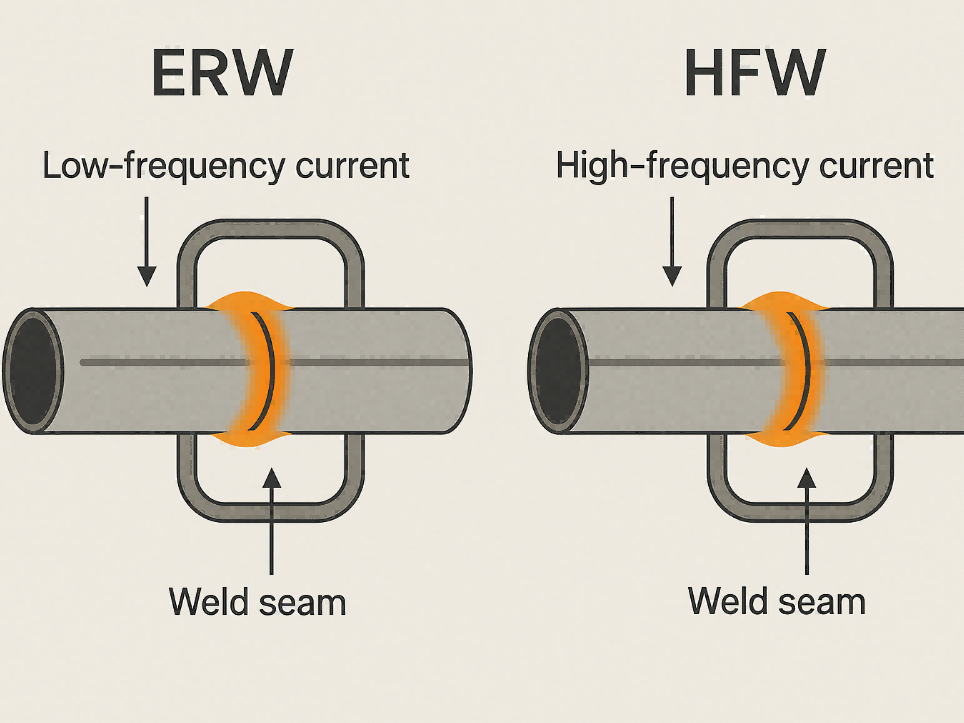
Manufacturing process, application scenarios and performance differences
ERW and HFW steel pipes differ in welding process, performance and application areas. Understanding the difference between the two will help to make material selection more scientific and procurement more efficient for industrial piping systems.
Among steel pipe products, ERW pipe (Electric Resistance Welded Pipe) and HFW pipe (High Frequency Welded Pipe) are often confused because of their similar concepts. In fact, HFW is a type of ERW process. There are certain differences between the two in welding methods, applicable scenarios and product performance. Understanding these differences will help scientifically select materials and improve the overall efficiency of industrial pipeline systems.
Process Differences
ERW is a general term for a type of resistance welding process, covering low-frequency (LF), medium-frequency (MF) and high-frequency (HF) resistance welding. In the early days, ERW pipes were mostly made of low-frequency resistance welding, and the weld quality was relatively low. In modern industrial applications, ERW pipes usually refer to high-frequency resistance welding (HFW), which uses high-frequency current to locally heat the edge of the steel strip to a molten state, supplemented by extrusion molding, and greatly improves the weld performance. It has been widely used in pressure pipeline systems.
Performance and Application Differences
HFW steel pipes are suitable for oil and gas transportation, boilers, structural pipes and other fields with high requirements for weld quality due to their narrow welding heat-affected zone, dense weld structure and high strength. Traditional ERW low-frequency welded pipes are currently mainly used in non-pressure occasions, and their application range is relatively limited. Most of the common ERW steel pipes in the modern market refer to HFW steel pipes. When selecting, you should pay attention to the specific process parameters of the product.
Cost and market awareness
HFW pipes have a slightly higher production cost than traditional ERW pipes, but their performance advantages are obvious. They have become the preferred product for mid-to-high-end industrial pipeline systems. Understanding the process differences will help accurately judge the value and applicability of products during the procurement process and avoid misselection.
MTSCO focuses on high-quality stainless steel, duplex steel, and nickel-based alloy pipeline system products, covering pipe fittings, flanges, pipelines, control pipelines, etc., and widely serves the petroleum, chemical, energy, marine engineering and other industries. If you have product needs or project consultations, please feel free to contact us. MTSCO will provide you with professional solutions and quality services to help your pipeline system operate safely and efficiently.