

 Español
 عربي
عربي Русский
 한국인
한국인 Português
 Türkçe
 Italiano
 Français
 German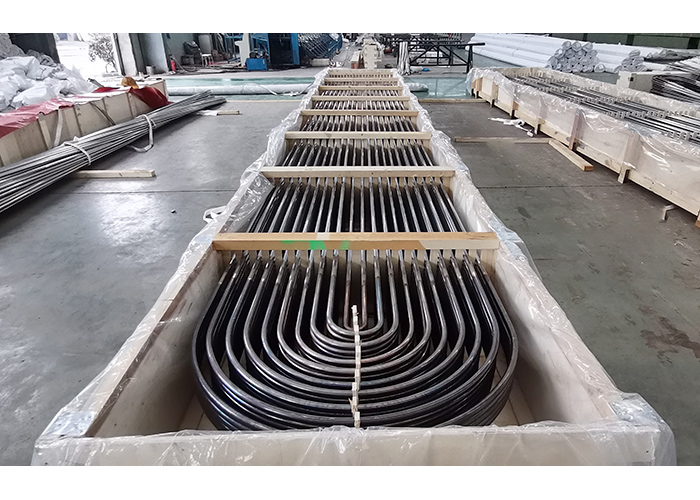
--Features, Materials and Manufacturing of U Bend Tubes
Discover the design, materials, and manufacturing standards of U Bend heat exchanger and condenser tubes used in power plants and chemical industries.
U Bend heat exchanger tubes
U Bend heat exchanger tubes are easy to identify. A straight tube is bent into a U-shape in the middle, with both ends fixed to the same tube sheet. Fluid enters and completes one round trip. This arrangement eliminates the need for a tube sheet at one end and allows space for thermal expansion and contraction of the tube. It is commonly found in power plant heaters and chemical heat exchangers.
Condenser tubes
Condenser tubes refer to their application. Steam or high-temperature gas releases heat on one side of the tube wall and condenses into a liquid, while a cooling medium removes the heat from the other side. Condenser tubes can be straight or U Bend. The two names often appear together; the selection depends on the equipment structure, medium, pressure, temperature, and cleaning method. If mechanical cleaning is required, the accessibility of the U Bend bend should be considered in advance.
Common materials include 304L and 316L austenitic stainless steel. For higher chloride ion content, duplex steel, nickel alloys, or titanium are also used. The pipe wall, separating two media over a long period, is susceptible to cross-contamination due to pitting, cracks, and minor leaks, which can affect heat exchange efficiency.
U Bend tubes are typically made from qualified seamless or welded pipes, cut to length, and then bent to the radius specified in the drawings. The bending section is the most demanding in terms of machining skill. Insufficient radius or inadequate support can lead to thinning of the outer arc, wrinkling of the inner arc, and flattening of the cross-section. After machining, the bending radius, straight leg length, flatness, ellipticity, and wall thickness variation must be checked. Some materials also require post-bending heat treatment to reduce residual stress.
Straight tubes are often manufactured according to standards such as ASTM A213 and ASTM A249. Austenitic stainless steel U Bend tubes for water heaters may also conform to ASTM A688. Finished products typically undergo eddy current or ultrasonic testing, hydrostatic or airtightness testing, and verification of surface, dimensions, and material records. Specific standards should be based on equipment design and procurement documents.
During procurement, passing the straight tube inspection is not enough; the dimensions and integrity of the bent section must also be confirmed. Material, pipe forming, bending, and inspection records must correspond to each other. After years of operation, the details that were overlooked during manufacturing often become the first to reveal problems with heat exchangers.